By Patrick Omorodion
Hundreds of teenagers have played in the FIFA World Cup throughout its history, with a record 22 teenagers alone participating in the recently held 48-team 2026 FIFA World Cup in North America’s Canada, Mexico and the United States.
When it comes to the ultimate stage, only five teenagers have ever played in a World Cup Final: Pelé (Brazil, 1958), Giuseppe Bergomi (Italy, 1982), Kylian Mbappé (France, 2018), Lamine Yamal (Spain, 2026) and Pau Cubarsí (Spain, 2026). All five of these players ultimately won the World Cup FIFA.
At the 2026 World Cup, Spain paraded two teenagers, Yamal and Cubarsi but Yamal, is not only younger than Cubarsi but made more headlines because he was playing against an icon, Lionel Messi who, almost 20 years earlier, bathed him in an advertorial when he was barely six months old.
The first teenager ever to play in a FIFA World Cup was Brazil’s Pelé, who made his tournament debut in 1958 at just 17 years and 236 days old. He remains a World Cup icon, as his debut in Sweden made him the youngest player ever to score in the tournament.
Since then, several teenagers have made their mark on the biggest stage, with recent sensations like Yamal making history by playing in the World Cup as a teenager.
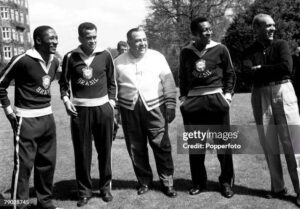
Talking about Pele, who the football world later crowned the King of football, he was thrown into history books by a man who risked his reputation and job as the coach of Brazil by playing an untested teenager into a match they seriously needed to move ahead in a competition they were yearning to win for the first time.
Before 1958, Brazil had played in all five previous World Cup finials in 1930, 1934, 1938, 1950 and 1954. There were no competitions in 1942 and 1946 because of the world war at the period.
They remain the only country that has appeared in all 24 editions of the World Cup.
At the inaugural edition hosted by fellow South American country, Uruguay in 1930, they had Píndaro de Carvalho as coach but he couldn’t steer them beyond the first round.
For a country that needed to win the World Cup so badly, they eased out Carvalho and brought in Luiz Vinhaes to lead them to the 1934 edition in Italy but again their attempt ended in the opening round.
The search for manager with the Midas touch continued after a second failure. This led them to hiring Adhemar Pimenta for the 1938 World Cup which France hosted. For the first time Brazil got to the medal range but lost to Hungary in the semi finals. Pimenta settled for the bronze after beating Sweden 4-2 in the third place match.
As Europe plunged into darkness with the world war after the 1938 edition which Italy won for second consecutive time, the first by any team, FIFA rested the competition for 12 years, in 1942 and 1946.
When the competition returned in 1950 with Brazil as host, they hired a new coach in Flávio Rodrigues Costa to handle the Seleção. Again he could only lead them to a runner-up finish, shockingly losing to fellow South Americans, Uruguay 2-1.
In 1954, they introduced their famous yellow shirt for the first time but the Seleção couldn’t go beyond the quarterfinals with a new coach, Zezé Moreira on the touchline.
After five attempts and with five different coaches, Brazil were determined to break the World Cup jinx, especially after rivals, Italy had won it back to back in 1934 and 1938 while Uruguay had also won twice in 1930 and 1950.
That was how Vicente Feola, born to Italian parents in Brazil, was appointed as head coach of Brazil’s national team in February 1958, barely four months to the start of the World Cup in Sweden.
Just as in Nigeria where the ministry of sports or the National Sports Commission, NSC as it is presently known, often takes the lead in search of coaches because of the huge salary involved, Feola was not appointed by the football federation in Brazil but by the Brazilian Sports Confederation (CBD).
He was said to have been chosen for his deep tactical experience at São Paulo FC and prior role as assistant coach during the 1950 World Cup campaign.
Feola took over four months to the World Cup and knew the desperation of Brazilians to be counted as winners of the prestigious World Cup which Italy and Uruguay had the bragging right of winning twice respectively.
But when it was time to assemble his squad, Feola looked everywhere, he didn’t limit his choices to known names and adults, he went to the grassroots, especially as a former handler of one of the Brazilian clubs with pedigree, São Paulo FC where he recorded multiple successes.
And one decision he took was not only going to the grassroots to scout for good players, he actually scouted a teenager, Edson Arantes do Nascimento, popularly known as Pele, who was 17 years and some months then.
Feola did not bother that a 17-year old was too young to work his way into the national team and that coaches who had tried their hands with the team didn’t risk inviting a teenager how much more listing him among the starting lineup.
Brazilian fans nor the older players in the squad never protested Pele’s inclusion. They respected his decision and choice, believing it was for the good of the team who needed to break the World Cup jinx to pacify their teeming fans.
Rather the opposition of Pele’s inclusion came from a member of the squad’s medical team, the Psychologist whose report after evaluating the players, stated that Pelé was “infantile,” lacked the necessary “fighting spirit,” and did not have the responsibility required for a major team tournament like the World Cup.
But a coach like Feola who knew what he wanted and would take the blame for his action reportedly ignored the psychologist’s evaluation and kept Pelé on the roster.
Years after, Pelé recalled Feola telling the psychologist, “You may be right. The thing is, you don’t know anything about football.”
Feola had players like Nílton Santos, a veteran defender who was 33 years old. He equally had goalkeeper Carlos Castilho, 30 years old and the second-oldest player in the squad.
From his club, São Paulo FC, he invited De Sordi, a defender, Mauro Ramos, defender and Dino Sani who played as a midfielder.
So believing that he was well equipped for the World Cup battle, Feola and his Brazilian army of players took off to Sweden with prayers from the football crazy fans back home.
When hostilities began for the La Seleção, despite his believe in Pele, he didn’t want to risk playing him immediately so he rested him in the first two group matches against Austria and England. They beat Austria 2-0 with goals from Altafini (2) and Nilton Santos and drew 0-0 with England.
Whether it was the barren draw against the Three Lions of England that got Feola scared or not, one cannot say but the fact remains that he took a gamble and gave the world something to cheer which has remained a record till date.
He handed Pele his debut appearance at the World Cup at a record age of 17 years and 236 days, youngest ever till this day.
Feola was not disappointed that Pele didn’t score in his debut match, the third group match against then Soviet Union because he believed he would score in subsequent matches.
After setting the record as the youngest player ever to feature in a World Cup match, Pele again set another record in the quarter-final match by scoring the lone goal that sent Wales packing, becoming the youngest ever to score in a World Cup match.
At that point Feola would have been the happiest man in the world, saying to himself, my gamble and believe in this teenager paid off after all. He may have kept the eulogy on Pele back then because two more battles, semi-final and final, lay ahead.
When the semi final match against France came, Feola, now emboldened ny Pele’s impact in the two matches he had played, didn’t hesitate to throw him into the pitch one more time.
This time the impact became louder. The same France that had the lethal striker, Just Fontaine who was topping the scorers chart before the semi-final match with 8 goals. He eventually ended the competition that year with 13 goals, the highest by any player in a single World Cup till date.
Pele seemed anonymous in the first half of the match as Vava and Didi scored Brazil’s first two goals. Who knows what Feola told him in the lockerroom at half time because the world saw another Pele in the second half.
He rampaged the entire pitch to the amazement of the French players who watched as the teenager struck a hattrick, his first at the World Cup that helped bury France 6-2 at the end.
To put an icing on his debut World Cup cake, Pele didn’t disappoint Feola as he netted two goals in addition to Vava’s two and Zagallo’s one to beat host Sweden 5-2 in the final as Brazil finally won the World Cup on their sixth attempt since 1930.
For his role in leading the Seleção to their first World Cup, Feola didn’t get much from the government back then as it is done in today’s world when players and coaches hit financial jackpot.
It is reported that he retained high standing in Brazil’s football administration and was reappointed to the national team in 1966.
This was after they won the World Cup again in 1962 to equal Italy’s back to back wins in 1934 and 1938.
His second term as national team coach was not successful, largely due to the injury sustained by his star kid player, Pele as they failed to go beyond the first round.
Though he left the team after that failed mission of an encore, his prodigy went on to re-establish himself as the star of the Selecao by leading them to their third World Cup title, overtaking Italy and Uruguay who had won it twice before Brazil won their first title in 1958.
Feola’s case is like a kingmaker who is never heard or heralded like the king he made.
Feola died on November 6, 1975, at the age of 65, unsung but his wonder player, Pele who died 47 years after on December 29, 2022, at the age of 82 was celebrated around the world.
