By John Egbokhan
Former Nigeria international Nathaniel Ogedegbe has offered to join Nigerians at home and abroad in providing “knowledge, experience, and service” as the country seeks to rebuild its football system from the schoolyard up. Ogedegbe made the appeal in an address to President Bola Ahmed Tinubu, following the resignation of the Ibrahim Gusau-led Nigeria Football on August 27, 2026, after the Super Eagles missed the second consecutive World Cup qualification and the Super Falcons failed to qualify for the 2027 Women’s World Cup; both for the first time.
Ogedegbe, a football hall of famer, warned that the vacancies created by the resignation of the entire NFF board alone does not amount to reform.
He said President Tinubu’s reform directive correctly identifies weak governance, narrow representation, broken pathways, struggling leagues and poor accountability, but stressed that, as Segun Odegbami has cautioned, simply replacing leaders without rebuilding the system would repeat the cycle of hope, controversy, failure and resignation. He called for the successful pathway that once connected schools, domestic clubs, youth teams and the national team to be restored, while drawing lessons from Spain, France and Morocco.
He also advocated competitive football in schools, greater responsibility for clubs in player development and welfare, fairer and more representative NFF elections, transparent football funding and measurable, time-bound reforms. Success, he said, should be measured by active school teams, registered boys and girls, licensed coaches, paid players, compliant clubs, safe pitches, published accounts, youth playing time and consistent qualification for major tournaments.
The President of Nathaniel Ogedegbe Soccer Foundation (NSOF) also called for the legal status of Nigerian football’s governing body to be settled. He noted that Nigerian law establishes the Nigerian Football Association, which adopted the NFF name in 2008 and is recognized by FIFA and CAF, while a Federal High Court reportedly rejected the name’s legal recognition in 2012, with the status of the announced appeal remaining unclear.
Ogedegbe urged the Attorney General to publish a legal opinion and the National Assembly to pass a modern law after consultation with government, football bodies, clubs, players, coaches, referees, women’s football and school sports. He said the law must protect technical autonomy while enforcing audits, lawful procurement and public accountability, stressing that “Autonomy cannot mean immunity.”
Ogedegbe, who said the old development pathway shaped his own journey, recalled how domestic clubs helped produce the 1980 AFCON title, while Lagos schools supplied the 1985 U-16 world champions. He cited Stephen Keshi’s rise from the St. Finnbarr’s Principals Cup team to captaining the country to the 1994 AFCON triumph and at Nigeria’s first World Cup appearance the same year, before leading Nigeria to its third AFCON title in 2013, while that generation also helped form the team that defeated Brazil and Argentina for the 1996 Olympic gold.
He recalled that while playing in the Lagos State Principals’ Cup, St. Finbarr’s College produced six players invited to the Flying Eagles, with Henry Nwosu and himself among them. Both were later invited to the senior national team during an AFCON campaign; Ogedegbe did not make an appearance and chose to pursue his studies abroad, while Nwosu remained in football and became a senior-team sensation. He also cited Godwin Odiye, Adokiye Amiesimaka, Segun Odegbami and Godwin Iwelumo as players who followed similar routes through school competitions and the domestic league.
Calling for Nigeria to learn from Spain, France and Morocco, Ogedegbe noted that Spain won the 2026 World Cup under Luis de la Fuente, who had coached its U-19, U-21 and Olympic teams, while France connects local scouting, regional centres, club academies and nearly 1,000 school sports sections while protecting education and personal development for players who do not become professionals. He said Morocco’s 2022 World Cup semi-final reflected investment in facilities, talent and qualified personnel.
For Nigeria, he proposed a continuous national development system led by a protected technical director, one coaching framework from U-13 through the senior teams for boys and girls, six properly staffed zonal centres linking schools, universities, clubs and accredited academies, and an academic-year National School Football League for U-13, U-15 and U-17 players.
He also called for digital identities linked to school and birth records, a unified national calendar, qualified coaches, transparent scouting, scholarships and schedules that protect education. Clubs, he said, must become the main employers and developers, with licensing tied to audited accounts, enforceable contracts, guaranteed wages, youth and women’s teams, medical support and safe grounds, while persistent wage defaulters should lose their licences.
Ogedegbe, owner of Ominira LLC, further demanded fixed domestic league calendars, dependable officiating, broadcasting, match data and enforceable commercial rules, as well as broader representation in NFF governance, independent integrity and conflict checks for candidates, public voter lists, nominations, campaign finance, decisions, results and term limits.
He said the NFF should report quarterly on government, FIFA, CAF, sponsorship, broadcasting, ticketing and major spending, and proposed a national football clock: within 100 days, publish the legal opinion, transition agreement and finances; within 12 months, establish school competitions and digital registration; within two years, enforce licensing, wage protections and youth leagues; within four years, track growth metrics; and within eight years, achieve regular tournament qualification.
He urged Nigerians to reject the search for a saviour promising instant trophies, while calling on former internationals to gain coaching and management qualifications, diaspora professionals to strengthen domestic development, and parents, schools, clubs, supporters and responsible businesses to rebuild local competition and reject age fraud.
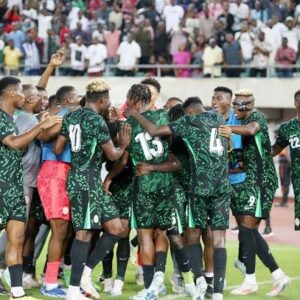
Super Eagles
“I am ready to join Nigerians at home and abroad in offering knowledge, experience, and service,” he said, urging the President to place people of integrity and vision where they can succeed.
Ogedegbe concluded: “Do not merely fill the vacant offices. Rebuild the system.”
